Is Medical-Grade Skincare Actually Better Than Natural Solutions?
Walk into any clinic, scroll through social media, or speak to a beauty professional, and you’ll likely hear the same message: medical-grade skincare is superior.
It sounds convincing—clinical, powerful, results-driven.
But is it actually better? Or is it simply better marketed?
The truth is far more nuanced. And understanding it can completely change how you care for your skin.
What Does “Medical-Grade” Actually Mean?
Let’s start here—because this might surprise you.
The term “medical-grade skincare” is not officially regulated.
That means:
- There is no universal standard
- No governing body defines what qualifies as “medical-grade”
- Any brand can technically use the label
Originally, it referred to products sold through dermatologists or clinics. Today, it’s often used as a marketing term designed to imply higher quality, stronger results, or scientific superiority.
That doesn’t mean all medical-grade skincare is ineffective—but it does mean the label alone doesn’t guarantee anything.
What Makes Medical-Grade Skincare Different?
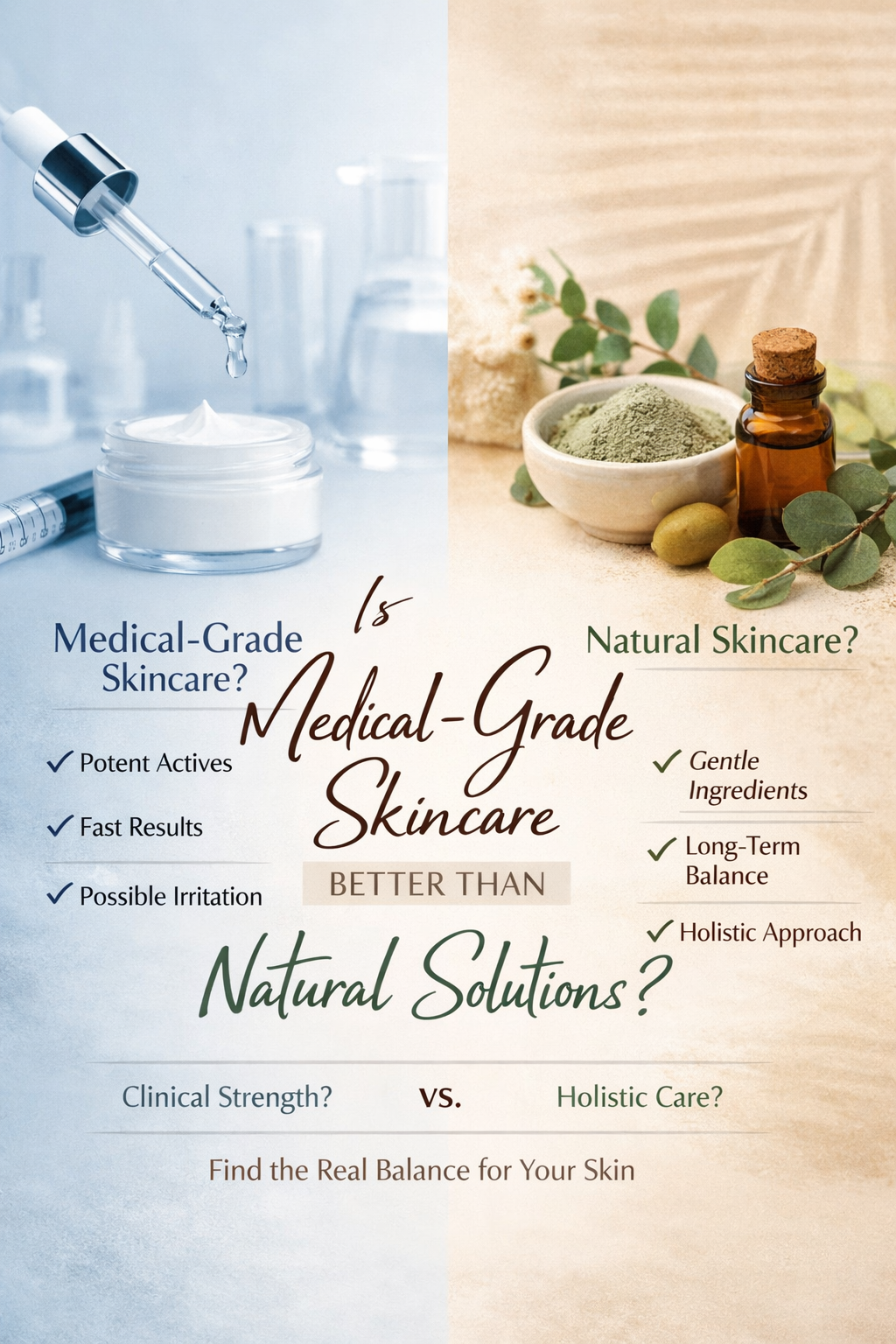
Where medical-grade products can stand out is in their formulation.
They often contain:
- Higher concentrations of active ingredients (like retinol, acids, peptides)
- Delivery systems designed to penetrate deeper into the skin
- Ingredients aimed at targeting specific concerns (acne, pigmentation, ageing)
These products are typically designed to treat rather than simply maintain the skin.
And in some cases—particularly for conditions like acne or melasma—they can produce faster, more visible results.
But there’s a trade-off.
The Downsides of Medical-Grade Skincare
More potent doesn’t always mean better for everyone.
Because of their strength, these products can:
- Disrupt the skin barrier
- Cause irritation, redness, or peeling
- Create dependency on continuous use
- Overstimulate the skin long-term
And importantly, stronger ingredients don’t automatically equal healthier skin.
Effectiveness comes down to formulation and suitability, not the label.
What About Natural Skincare?
Natural skincare sits at the other end of the spectrum—and is often misunderstood.
Typically, natural products:
- Use plant-based ingredients, oils, and minerals
- Focus on supporting the skin rather than forcing change
- Work in harmony with the skin’s natural processes
They’re often associated with:
- Gentle, nourishing care
- Long-term skin health
- A more holistic approach
But it’s important to be clear:
Natural does not automatically mean safe or better.
Some natural ingredients—especially essential oils—can irritate the skin or trigger reactions.
So again, it’s not about labels. It’s about understanding what your skin actually needs.
Results: Fast vs Sustainable
One of the biggest differences between these two approaches is how they deliver results.
Medical-grade skincare
- Often works quickly
- Targets specific concerns aggressively
- Can visibly transform the skin in a shorter time
Natural skincare
- Works more gradually
- Focuses on strengthening and supporting the skin
- Encourages long-term balance and resilience
Think of it like this:
- Medical-grade = intervention
- Natural = support
Neither is inherently “better”—they simply serve different purposes.
The Skin Barrier Conversation
Your skin barrier plays a crucial role in overall skin health.
When it’s functioning well:
- Skin appears more radiant
- Hydration is retained more effectively
- Protection against irritation and environmental stress is improved
Many intensive skincare routines—especially those involving frequent use of strong acids or retinoids—can compromise this barrier if not used carefully.
Natural skincare approaches often prioritise:
- Nourishing lipids
- Supporting microbiome balance
- Reducing inflammation
This is one reason why more people are beginning to shift toward gentler, supportive routines.
Why More People Are Rethinking “Stronger Is Better”
There is a growing shift in how people approach skincare.
Instead of focusing purely on correction or perfection, many are moving toward:
- Simplicity
- Skin health over quick fixes
- Long-term sustainability
This includes questioning:
- Over-exfoliation
- Harsh treatments
- The idea of needing to “fix” natural ageing
As a result, more balanced and intuitive skincare routines are becoming popular.
The Role of Marketing in Skincare Choices
Marketing plays a significant role in how skincare products are perceived.
Terms like:
- “Medical-grade”
- “Clinical strength”
- “Clean”
- “Non-toxic”
…are often used to create a sense of superiority or urgency.
However, many of these terms are not strictly regulated and can be misleading.
The reality is simple:
A product’s effectiveness depends on:
- Its ingredients
- Its formulation
- How well it suits your individual skin
Not just the label on the packaging.
So… Is Medical-Grade Skincare Better?
The honest answer is:
Sometimes—but not automatically.
Medical-grade skincare can be beneficial if:
- There are specific skin concerns or conditions
- Targeted treatment is needed
- Products are used correctly and appropriately
Natural skincare may be a better choice if:
- The focus is on long-term skin health
- Skin is sensitive or reactive
- A gentler, more holistic approach is preferred
Ultimately, neither approach is universally superior.
A More Balanced Approach
The most effective skincare routines are rarely extreme.
They tend to be:
- Thoughtful
- Personalised
- Balanced
For many people, this might include:
- A gentle, supportive base routine
- Occasional use of targeted actives where appropriate
- A strong focus on maintaining the skin barrier
Because skin doesn’t need to be forced into change—it needs to be supported.
Final Thoughts: It’s About What Works for You
Skincare isn’t about choosing sides.
It’s about choosing what aligns with:
- Your skin’s needs
- Your values
- Your lifestyle
Medical-grade skincare isn’t automatically superior.
Natural skincare isn’t inherently safer.
Understanding your skin—and moving away from marketing-driven decisions—allows for a more confident and informed approach.
Because ultimately, healthy skin is not about stronger products.
It’s about consistency, balance, and care.